Posts

Army Aviation Airbases

Image
Iran's Army Ground Forces (NEZAJA) includes a substantial rotary-wing aviation component commonly known as the Havanirooz. The hundreds of Bell helicopters purchased during the 70s and the facilities built to operate and maintain them still form the backbone of the service. Today, they are tasked with supporting the NEZAJA's corp-level headquarters with attack and air-transport capabilities (the latter including airborne assault, and logistics). The Havanirooz falls under the authority of the NEZAJA's central command. (1) However, it is assessed with high confidence that their constituent elements are also operationally subordinate to the NEZAJA's regional headquarters. The force's current commander is BG2 Houshang Yari, who has held this position since September 2011. (2) Prior to his appointment, he was the force's deputy commander. (3) The staff headquarters is located in Tehran, within the NEZAJA HQ. Below this, the Havanirooz's staff-level organizat...
Operation Beit al-Moqdas (1982) - An Institutional Perspective from Iran's Army Ground Forces (Working Copy)

This report is a brief look at one of the more important operations in the Iran-Iraq War. The purpose of this report is to illustrate some of the Army Ground Forces history, and the way it has shaped their development over the past three decades. It is loosely intended to precede a more thorough treatment of the current doctrine and structure. Introduction : "A year and a half after the Iran-Iraq War began in September 1980, Tehran launched Operation Beit al-Moqdas, the final operation in its campaign to expel the Iraqi Army from its territory. Today, the operation holds a special place in the national memory and in the official narrative that instrumentalizes the war's symbols. The operation has also shaped the world-view of the contemporary Iranian military. In particular, for the Army Ground Forces (NEZAJA), it has been used to help articulate their doctrine and reconcile their identity as a professional service within a Revolutionary system." Google Docs Link (pdf) Th...

Defense Expenditures in Iran's 1394 Budget

Image
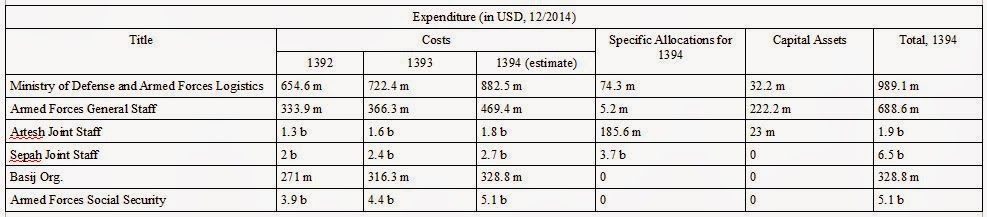
More so than other translations, the highly technical nature the budget reports means that the relative simplicity of the following tables hides potential difficulties in not just translating Persian to English, but financial-speak to layman-speak. At a Glance : - High disparity between the Army and IRGC's funding. Even ignoring the one-time allocation to the IRGC's Khatem al-Anbiya organization (see below), IRGC receives a billion more than the Army. Ministry of Defense and Armed-Forces Logistics : - Large quantity of ministry's funding earmarked for the ambiguously titled "strengthening/promoting defense". - At first glance, industrial defense base (IEI, HESA, AIO) will recieve a paltry sum. However, since this is listed under capital assets, their actual funding may be buried elsewhere in the budget (e.g. "strengthening defense", or "maintaining defense industrial production"). Armed Forces General Staff : - Not insignificant amount earmarke...

The Fakour and Rasool Air-Defense Components

Image
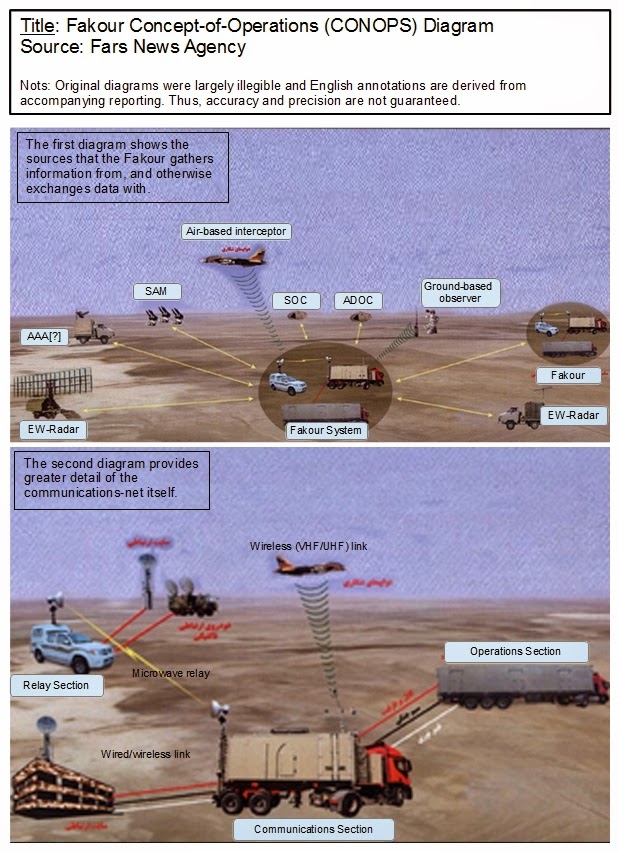
At the request of a reader, we now take a brief look at two different elements of Iran's integrated air defense system (IADS). Introduction : On May 25 2014, the Khatam al-Anbiya Air Defense Headquarters (aka IRIADF) unveiled two new systems that they reported would soon enter production. [1] These were: 1) The Fakour command-and-control (C2) system, which is responsible for gathering, fusing, and distributing tactical information within the IRIADF's sectors. 2) The Rasool communications system, which is responsible for linking the Matla ul-Fajr radars with other elements of the air-defense network. Fakour : The Fakour is employed as a command-post for fusing and distributing sensor information at the tactical level. This means gathering data from a range of sources, which is reported to include active sources such as military and civilian radars, passive ELINT such as emission-finders, and air-defense units such as SAM batteries. This data is fuzed to produce a unified pictur...

Basij Organization - The Shahid Shushtari Operating Base

Image
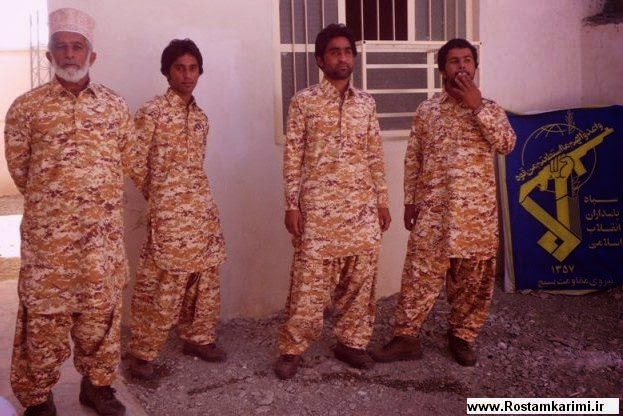
In the fifth part of the 'Basij Organization' series, we now turn to one of the so-called special categories of Basij: the Shahid Shushtari Operating Bases (SSOB) in Iran's restive south-east. The first part in this series covers the Imam Hussein battalions. The second part covers the Beit al-Moqdas battalions. The third part covers the the Semnan province Basij. The fourth part covers the Imam Ali battalions Baluch Basij, pictured during the opening of a base in Qasr-e Qand Index : Index Abbreviations/Acronyms Intro Origin and Development External Organization Internal Organization Appendix: Shahid Shushtari Footnotes / Works Cited Abbreviations/Acronyms : BG – Brigadier General BG2 – Brigadier General, 2nd Class Cmdr - Commander Col. – Colonel HQ – Headquarters IRGC [-GF] – Islamic Revolutionary Guards Corps [Ground Forces] MG – Major General SM [HQ] – Shahid Mamar [Headquarters] SSOB – Shahid Shushtari Operating Base S&B - Sistan va Baluchistan Intro : Since 2012...

IRIN Naval Regions

Image
With an increasing emphasis on power projection, the Islamic Republic of Iran Navy (IRIN) is responsible for Iran's maritime security in the Caspian Sea, Gulf of Oman, and the greater Indian Ocean. The IRIN is organized into four or five naval regions, details about some of which are unclear. These administrative and/or operational divisions are believed to be largely equivalent to other services' 'regional headquarters'. 1st Naval Region – Bandar Abbas : The 1st region, as well as the IRIN's general HQ, is co-located with the IRGCN in Bandar Abbas. As of 11/2013, it is commanded by Vice-Admiral (hereafter, BG2*) Hossein Azad. [1] * This article employs generic nomenclature for titles (e. g. Brig. Gen. / Mag. Gen. ) rather than their naval-specific equivalents (e.g. Rear Admiral / Admiral ) in order to si mplify the issue a s much as possible, and make it clear which posit ions are equivalent to one another . 2nd Naval Region – Bandar Bushehr or Bandar Jask : Mul...

Basij Organization - The Imam Ali Security Battalion

Image
In the fourth part of 'Basij Organization' series, we look at the organization and role of the Imam Ali security battalions (IA bn). The first part of this series covered the Imam Hussein battalions. The second part covered Beit al-Moqdas battalions. The third part took a look at Basij in Semnan province. Imam Ali bn personnel, during a December 2013 exercise in Khuzestan Index : Origin Acronyms and Abbreviations Role Organization (external) Organization (internal) Footnotes Acronyms and Abbreviations : bn - Battalion BaM - Beit al-Moqdas [bn] IA – Imam Ali [bn] IH – Imam Hussein [bn] IRGC – Islamic Revolutionary Guards Corps Origin : The groundwork for the creation of the Imam Ali security battalion was laid in 2007 when Gen Ali Jafari was appointed to the position of IRGC commander in 2007. Jafari then initiated a well-known restructuring that included strengthening Basij response capabilities across a range of kinetic and non-kinetic domains, while also further integrat...